History & Perspectives
While We're Having Our Morning Coffee, We're Traveling Through Space at 514,000 MPH (828,000 km/h)
A morning coffee, a planet racing through space, and the questions science and faith still cannot settle.
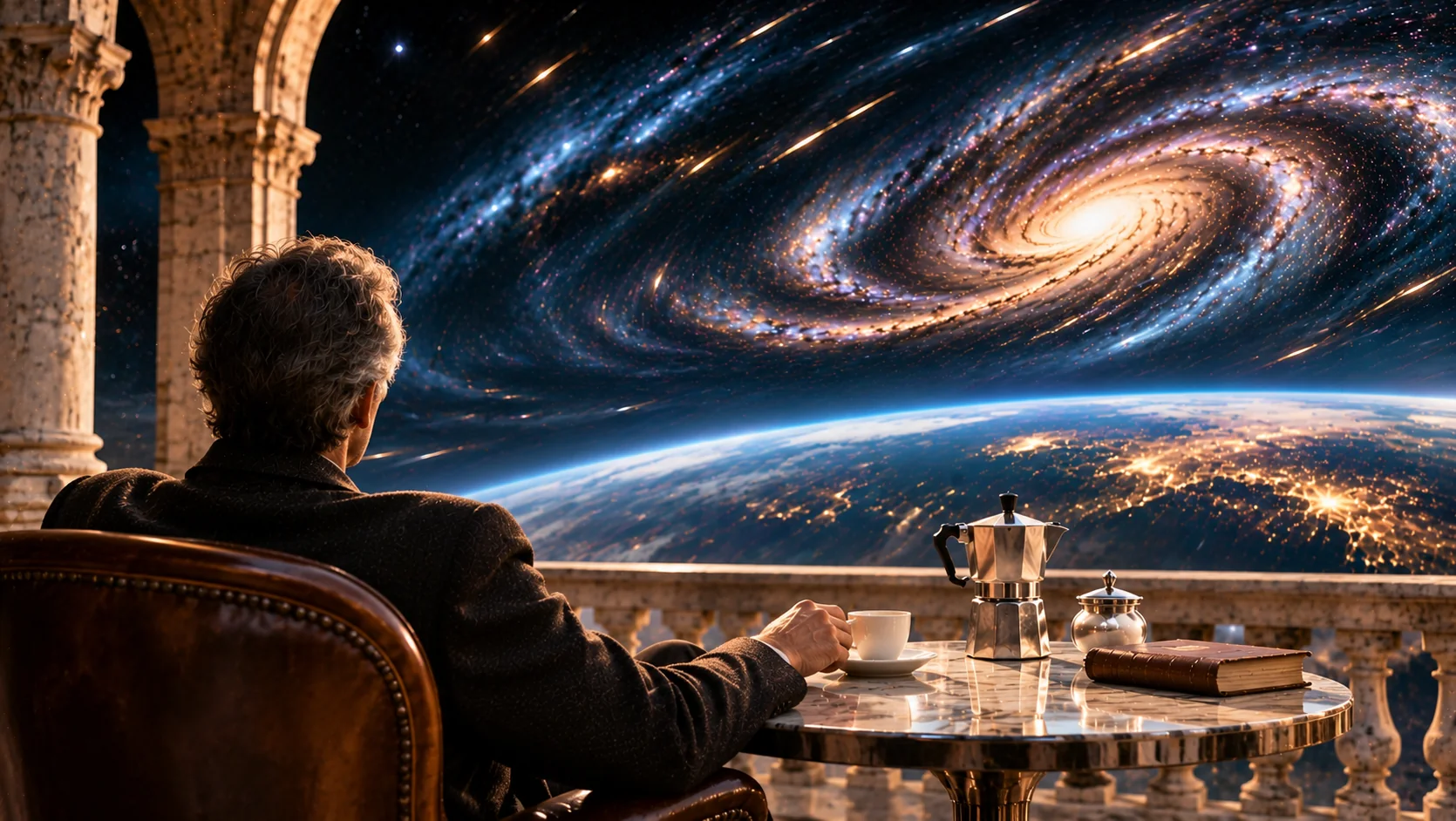
Imagine an ordinary morning. We're sitting at the kitchen table, drinking coffee, perhaps checking the news before work. The cup is motionless. The walls are still. Outside, nothing seems to be moving.
Except almost everything is.
At the equator, Earth rotates at approximately 1,040 miles per hour (1,670 km/h). It orbits the Sun at roughly 67,000 miles per hour (107,000 km/h). And our Solar System travels around the center of the Milky Way at approximately 514,000 miles per hour (828,000 km/h).
These motions are measured relative to different reference points; their speeds cannot simply be added together. Yet the image is extraordinary: our homes, our coffee cups, and everyone we know are traveling through space, even when the world feels perfectly still.
We are passengers on a planet moving through an immense universe, and most mornings we barely give it a thought.
What we know — and what we don't
We have identified the elements in distant stars, mapped the structure of DNA, detected gravitational waves, and observed galaxies whose light has traveled for billions of years. Science has transformed our understanding of existence.
Modern cosmology describes an observable universe that evolved from an extremely hot, dense early state about 13.8 billion years ago. Its expansion and the cosmic microwave background provide powerful evidence for that history.
But what explains those earliest conditions? Did time have a beginning? Why does anything exist at all?
Physicists are investigating possible answers, including models that envision earlier cosmic phases. None has established a universally accepted explanation for the ultimate origin of existence. And that question is philosophical as well as scientific.
The mystery Einstein could not ignore
Albert Einstein helped transform our understanding of space, time, and gravity. Yet one feature of the universe continued to astonish him: that human beings could understand it at all.
Nature follows patterns that mathematics can describe. Equations developed on paper can predict the motion of planets or the behavior of light. Why should a mind shaped on one small planet be capable of discovering laws that apply across the cosmos?
Einstein regarded the comprehensibility of the world as a profound mystery. He did not mean that physics had proved the existence of God. His religious outlook was unconventional, and he rejected the idea of a personal God who intervenes in human affairs.
His wonder points to a question that scientific discoveries can sharpen without necessarily settling: why is the universe intelligible in the first place?
Faith inside the scientific world
Some scientists have gone further than wonder, embracing religious faith. Georges Lemaître, whose work helped lay the foundations of Big Bang cosmology, was also a Catholic priest. He insisted on distinguishing a scientific account of the universe from theological claims about its meaning.
Cambridge physicist John Polkinghorne became an Anglican priest after a career in theoretical physics. Geneticist Francis Collins, a leader of the Human Genome Project, has described his journey from atheism to Christianity as a matter of philosophical reflection and personal experience, not a laboratory discovery of the supernatural.
These scientists did not share identical beliefs or experiences. Their lives nevertheless challenge the idea that intellectual rigor and religious faith must always be enemies.
Could reality be stranger still?
Even physics can overturn what feels obvious. The holographic principle, associated with Gerard 't Hooft and Leonard Susskind, proposes that in certain theoretical settings, information about a region of space can be represented on a lower-dimensional boundary. Juan Maldacena's work gave related ideas a powerful mathematical expression in particular models.
That does not prove our universe is a hologram, that the world is an illusion, or that God is projecting reality. It suggests something more modest and still astonishing: our everyday intuition about space may be incomplete.
The more we discover about the universe, the more carefully we must distinguish what we know from what we imagine.
Where does God enter the conversation?
For many people, the mystery of existence points toward God. For others, it is a question awaiting a natural explanation, or one that may never be settled. Science, philosophy, history, and religious faith approach it through different methods.
Within Christianity, the question becomes personal through Jesus of Nazareth. Historians broadly accept his existence and crucifixion in Roman Judea. Claims about his divinity and resurrection belong to religious belief and historical interpretation, not findings established by laboratory experiments.
There is room to respect scientific evidence without pretending that it settles every question of meaning. There is also room for faith without asking science to certify what it cannot test.
Tomorrow morning
Tomorrow, we may sit down with another cup of coffee. Earth will still be rotating, orbiting the Sun, and traveling with the Solar System through the Milky Way. Our kitchen will seem as quiet as ever.
Somewhere on this small moving planet, someone will look up at the sky and wonder why any of it exists.
We know an extraordinary amount about how we got here. We have much more to discover. And perhaps the greatest mistake would be to stop asking.
Sources & further reading
- NASA Science — Solar System Facts
- NASA Science — The Universe
- Albert Einstein, “Physics and Reality” (1936), Journal of the Franklin Institute
- Francis S. Collins, The Language of God (2006)
- Juan Maldacena, The Large N Limit of Superconformal Field Theories and Supergravity (1997)
- John Polkinghorne, Science and Christian Belief (1994)