Healthy Recipes & Nutrition
High-Fiber Breakfast Ideas for a Healthier Morning
Forget sugary cereals and refined flour. A truly satisfying breakfast begins with real food, a little wisdom, and the pleasure of eating well.
My grandmother would have been unimpressed by the American breakfast aisle. Faced with rows of colorful cereal boxes promising boundless energy and a glorious start to the day, she would probably have asked why anyone needed so much advertising to sell breakfast.
Her idea of a proper morning meal was less fashionable. Eggs, perhaps some leftover beef, vegetables from the garden. If there was steak in the refrigerator, she saw no reason to save it for dinner.
She wasn't a nutritionist, and some of her convictions would struggle under scientific scrutiny. But she understood the difference between eating something and having a proper meal. Breakfast, in her opinion, ought to keep you satisfied long enough to get on with your day.
The Breakfast That Leaves You Hungry Again
It's ten in the morning. You ate breakfast barely two hours ago, yet you're already looking for something sweet. Another coffee, perhaps a cookie from the office kitchen. The cereal that seemed perfectly satisfying at eight has done very little to carry you through the morning.
A breakfast dominated by refined carbohydrates and added sugars can produce a rapid rise in blood glucose, followed by a decline. For some people, hunger returns sooner than expected, accompanied by a desire for another sweet snack.
We call it a sugar craving, although appetite is influenced by far more than blood glucose alone. Sleep and stress have their say, too. But the contents of the breakfast bowl deserve some attention.
A serving of sweetened cereal eaten alone has little in common nutritionally with eggs and avocado or Greek yogurt with chia seeds. Protein helps promote fullness, while fiber slows digestion and contributes to a steadier absorption of carbohydrates.
Whole grains are another matter. Oats and other minimally processed grains provide valuable fiber and have earned their place in a healthy diet. The trouble lies with breakfast products built largely around refined flour and added sugar, especially when protein is scarcely represented.
My grandmother would have expressed the entire argument in five words:
Eat something that will last.
1. The Grandmother's Breakfast: Steak, Eggs & Avocado
There is something deliciously rebellious about putting steak on the breakfast table. Americans think nothing of bacon or sausage in the morning, yet a modest serving of lean beef somehow feels like breaking the rules.
The clock, fortunately, has no opinion about when we eat protein.
Ingredients — 1 serving
- 3.5 oz (100 g) lean beef steak
- 1 egg
- ½ medium avocado
- 1 cup baby spinach
- ½ cup cherry tomatoes
- 1 teaspoon extra-virgin olive oil
- Lemon juice, black pepper, and fresh herbs
Preparation
Season the steak and sear it in a hot skillet until it reaches a safe internal temperature. Let it rest while you cook the egg thoroughly and briefly wilt the spinach in olive oil. Arrange everything on a plate with sliced avocado and cherry tomatoes. Finish with lemon juice and herbs.
The steak provides protein, iron, and vitamin B12; the egg contributes additional protein. Neither contains dietary fiber. That comes from the avocado and vegetables, which give this decidedly savory breakfast its nutritional balance.
Estimated dietary fiber: 6–8 grams.
Red meat is best enjoyed in moderation, and this breakfast is certainly substantial. On another morning, the same vegetables would be excellent with eggs alone.
2. Greek Yogurt with Raspberries, Chia & Walnuts
For anyone who considers cooking before coffee an unreasonable demand, this bowl is a civilized alternative.
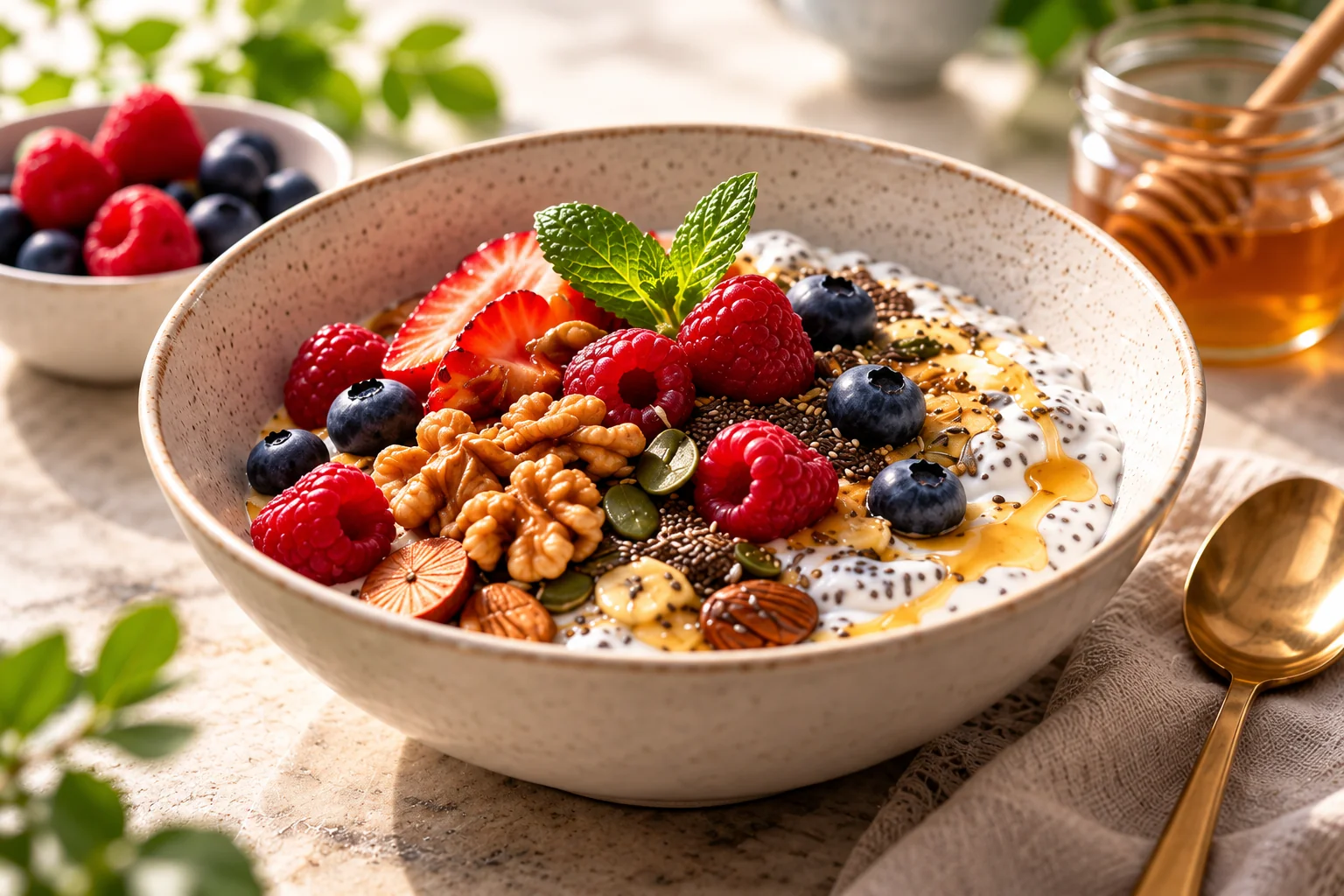
Creamy yogurt, tart raspberries, the delicate crunch of walnuts: it takes five minutes to assemble and looks entirely at home on a café breakfast menu.
Ingredients — 1 serving
- 6 oz (170 g) plain, unsweetened Greek yogurt
- ½ cup raspberries
- 1 tablespoon chia seeds
- 2 tablespoons chopped walnuts
- A pinch of cinnamon
Preparation
Spoon the yogurt into a bowl and add the raspberries. Scatter the chia seeds and walnuts over the top, then finish with cinnamon. Let the mixture stand briefly so the chia seeds absorb some moisture.
Greek yogurt provides protein without the added sugar common in flavored varieties. Raspberries and chia seeds supply most of the fiber, while walnuts contribute unsaturated fats.
Estimated dietary fiber: 9–10 grams.
Frozen raspberries are perfectly suitable when fresh berries are expensive or out of season. There is no nutritional prize for paying twice as much for fruit in a plastic container.
3. Mediterranean Eggs with Artichokes & White Beans
Beans for breakfast may raise an eyebrow in an American kitchen, although elsewhere they are perfectly ordinary morning fare. Here, cannellini beans and artichokes meet eggs, olive oil, and lemon in a dish that would be equally welcome at brunch.
Ingredients — 1 serving
- 2 eggs
- ½ cup cooked cannellini beans, rinsed
- ½ cup cooked artichoke hearts
- 1 cup baby spinach
- 1 teaspoon extra-virgin olive oil
- Fresh parsley, lemon zest, and black pepper
Preparation
Warm the beans and artichoke hearts in a skillet with olive oil. Add the spinach and cook until wilted. Prepare the eggs separately, cooking them thoroughly, and place them over the vegetables. Finish with parsley, lemon zest, and black pepper.
The eggs supply protein; the beans and artichokes provide most of the fiber. The lemon zest gives the dish a welcome brightness.
Estimated dietary fiber: 10–12 grams.
Canned beans work beautifully here. Rinsing them removes some of the sodium, and anyone sensitive to legumes can begin with a smaller portion.
A Little More Protein, a Little Less Sugar
There is a reason to pay attention to fiber beyond the breakfast table. Most American adults consume less than recommended, and the Dietary Guidelines for Americans, 2020–2025 identify a range of approximately 22–34 grams daily, depending on age and sex.
A breakfast providing six to twelve grams offers a useful start. Protein adds staying power, particularly when the alternative is a bowl of refined cereal with little else to accompany it.
Of course, no breakfast guarantees a hunger-free morning. Appetite is personal, and someone who spends the morning exercising will have different needs from someone sitting at a desk. Those unused to eating much fiber should increase it gradually, with adequate fluids, to avoid digestive discomfort.
The most appealing solution is also the simplest: choose ingredients worth eating and give them enough substance to make a meal.
What My Grandmother Understood About Breakfast
My grandmother never discussed glucose curves or appetite hormones. She judged breakfast by whether it tasted good and whether you would be asking for something else before lunch.
I suspect she would have little patience for a cereal box announcing that its contents were part of a balanced breakfast. She would want to see the rest of that breakfast first.
And if she were here today, she would probably offer me another helping of steak. I might decline the second portion.
I would, however, take another slice of avocado.
Sources & further reading
- U.S. Department of Agriculture and U.S. Department of Health and Human Services — Dietary Guidelines for Americans, 2020–2025
- USDA FoodData Central — Nutrient composition and dietary fiber values
- Centers for Disease Control and Prevention (CDC) — Fiber, carbohydrates, and blood sugar
- National Institute of Diabetes and Digestive and Kidney Diseases (NIDDK) — Dietary fiber and digestive health
- American Heart Association — Recommendations on added sugars and whole grains
Fiber estimates are approximate and depend on portion sizes and ingredient varieties. This article provides general nutritional information and is not a substitute for individualized medical advice.